Sāmoan Tatau: Understanding a Living Cultural Tradition
Consider Sāmoan tatau through living communities, cultural relationships, and the voices of practitioners rather than a catalog of motifs.
Start with people and relationships
Sāmoan tatau should be approached as a living cultural practice, with meanings connected to the people and communities who carry it. A pattern seen online is only one visible part of a much larger subject. Understanding begins with listening to practitioners, wearers, and researchers who can place the work in its social setting. An image alone cannot provide that context.
Continuity does not mean stillness
In a Te Papa interview about their history of Sāmoan tattooing, Sean Mallon and Sébastien Galliot describe a tradition shaped by both continuity and change. Their discussion challenges the idea that cultural practice is authentic only when it remains frozen. It also emphasizes relationships and the ways tatau operates in people’s lives. This offers a more useful starting point than trying to assign a universal translation to every visible line.
Use precise language
The Pacific encompasses distinct peoples and traditions. Broad labels can erase the differences that make each practice meaningful. When writing or speaking about a particular work, identify its context as accurately as the available information allows. Name the practitioner when permission and reliable attribution are available. Avoid treating a design as an interchangeable decorative resource just because it appears in a public photograph.
Learn through accountable sources
Begin with community voices, practitioner accounts, and carefully researched cultural institutions. Read beyond a single caption and notice whose perspective an account represents. Appreciation can take the form of learning, supporting artists, and understanding the responsibilities surrounding the work. A thoughtful encounter with tatau makes room for its living complexity rather than reducing it to a ready-made visual style.
Further reading
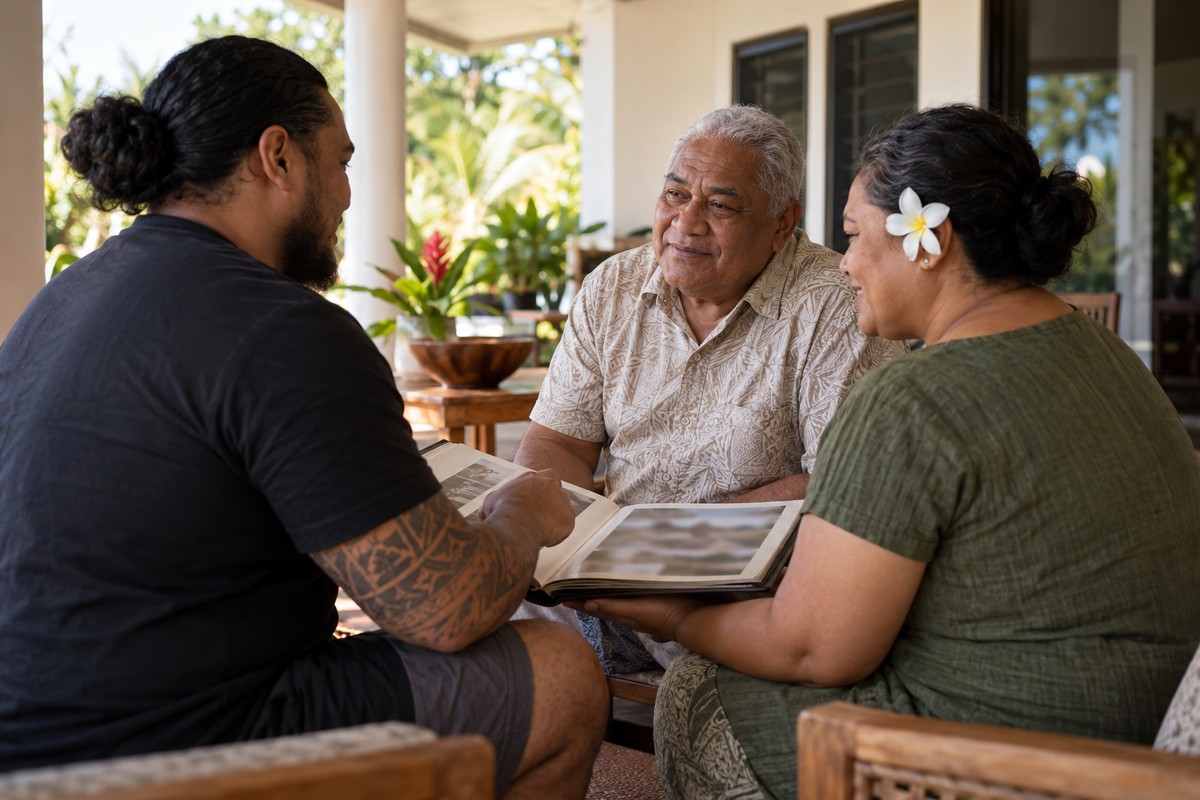
Read Te Papa’s interview with Sean Mallon and Sébastien Galliot. The generated feature image illustrates contemporary community conversation; it does not document a specific tatau practitioner or ceremony.